
3 days in Berlin: Three days, one extraordinary city, and a journey that was about to change my life.
On my way to Congo for the first time, I spent 3 days in Berlin.
Berlin was never supposed to be the destination.
I was on my way to Kinshasa, the sprawling capital of the Democratic Republic of Congo, where I was preparing to begin a new chapter of my life. But somewhere between the life I was leaving behind and the one waiting for me in Central Africa, I found myself with a three-day layover in Berlin, Germany.
Three days isn’t much time to get to know a city. But it’s enough time to wander its streets, absorb its history, and begin to understand why Berlin is unlike anywhere else in Europe.
And what a fascinating place to find myself on the way to Africa.
Explore This Story
Berlin: A City That Carries Its History Everywhere
There are cities where history is tucked away inside museums, and then there is Berlin, where history seems to rise out of the pavement beneath your feet.
Few cities have witnessed such extraordinary political and social transformation in the last century.
Berlin was the capital of Nazi Germany, devastated during World War II, divided between East and West during the Cold War, and finally reunited after the fall of the Berlin Wall in 1989.
Walking through the city, I was struck by how visibly its past remains woven into everyday life.
Modern buildings stand beside monuments to war and division. Streets once separated by concrete walls and armed guards now bustle with tourists, cyclists, and commuters.
It’s a city that has been broken apart and put back together again.
And somehow, that makes it all the more interesting.
Checkpoint Charlie: Where Two Worlds Collided
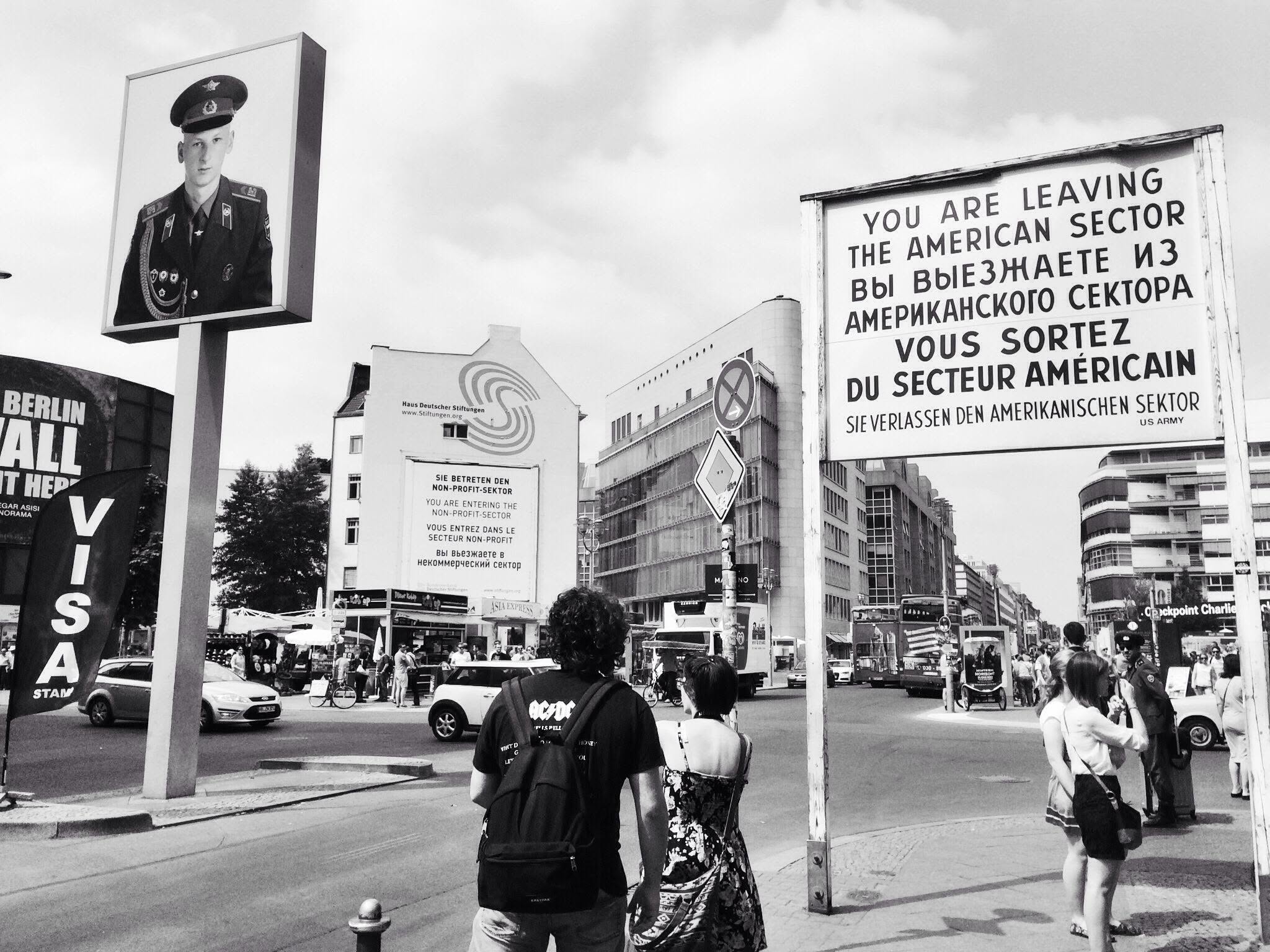
With only 3 days in Berlin, I decided to spend my days learning about its history. One of the most fascinating places I visited during my three days in Berlin was Checkpoint Charlie.
During the Cold War, this famous border crossing separated the American and Soviet sectors of Berlin and became one of the most recognizable symbols of the division between East and West.
Today, the checkpoint is surrounded by traffic, souvenir shops, and tourists snapping photographs.
But standing beneath the famous sign reading “You Are Leaving the American Sector,” I couldn’t help thinking about what those words once meant.
There was a time when crossing this street could change your life—or end it.
Families were divided. Friends were separated. People risked everything to escape from one side to the other.
And now, decades later, people casually walk across the same intersection without giving it a second thought.
What an extraordinary reminder of how quickly the world can change.
The Berlin Wall: A Line That Divided a City
Another powerful experience was seeing the remnants of the Berlin Wall.
For nearly three decades, the wall physically and symbolically divided Berlin, becoming one of the most recognizable representations of the Cold War.
Construction began in 1961, and the border opened on November 9, 1989, setting in motion the events that would lead to German reunification.
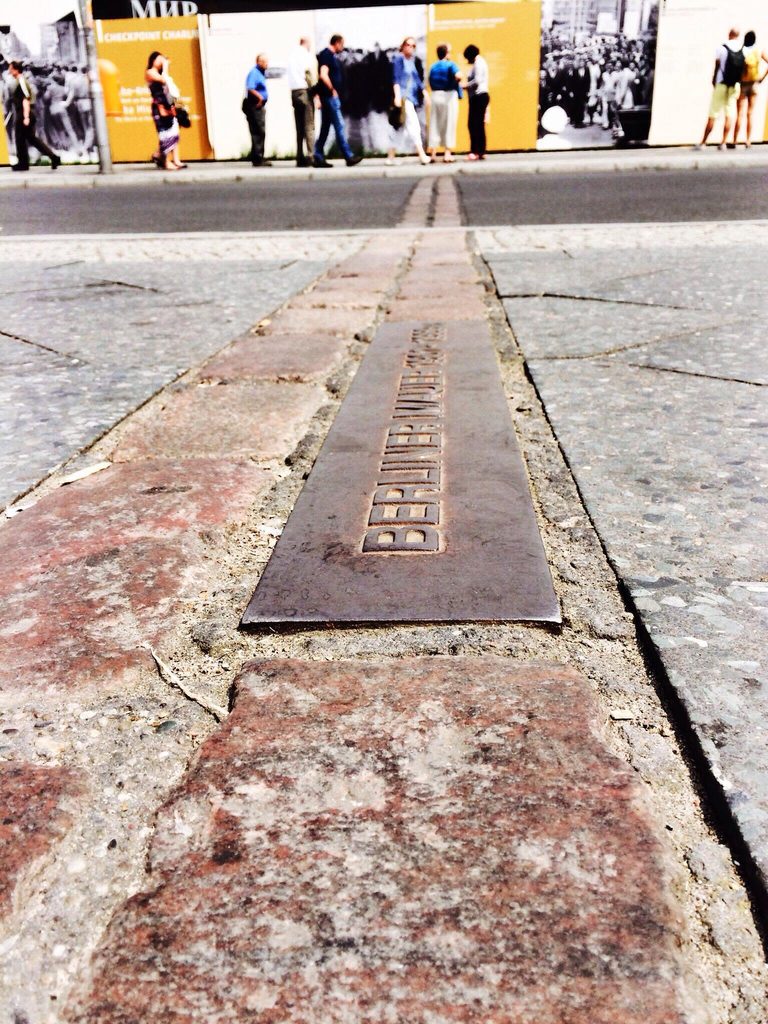
Today, sections of the wall have been preserved, and traces of its former route remain marked throughout the city.
In one of my photographs, a metal marker embedded in the pavement reads Berliner Mauer—Berlin Wall.
It’s such a simple thing.
A line in the ground.
Yet that line once determined where people could live, work, travel, and whom they could see.
Standing there, I found myself thinking about all the invisible lines we draw between people, countries, cultures, and ideologies.
And how much of our world is shaped by boundaries that human beings invented. But also their willingness to step over these boundaries once a true and lasting friendship evolves. It reminds me so much of my Russian friend Miche, who I lived with in Moscow for a month during high school. We shared a room, and in that month we became best friends and brother and sister. And we promised each other that no matter what happened between our countries, we would be friends forever.
Read Miche’s letter and journal entries from Moscow in the Magic Circle.
Brandenburg Gate: A Symbol of Division and Unity
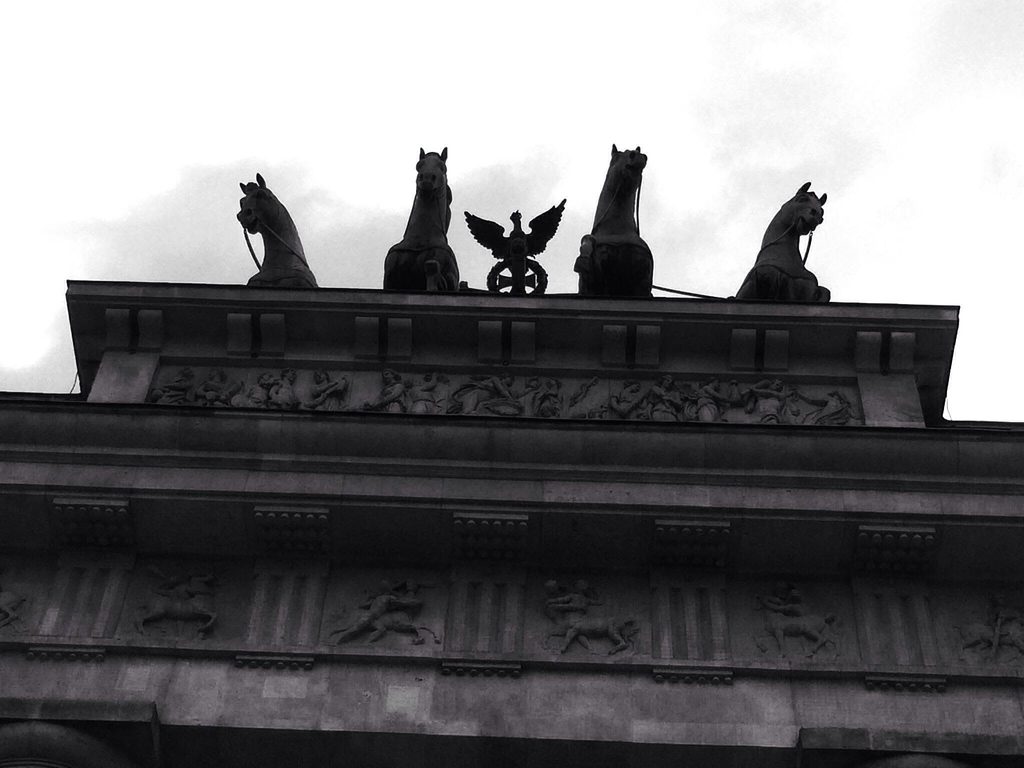
No visit to Berlin would be complete without seeing the Brandenburg Gate.
Built in the late 18th century, this neoclassical monument has witnessed some of the most consequential events in modern European history.
During the Cold War, the gate stood in the restricted border zone near the Berlin Wall, inaccessible to ordinary visitors from either side.
Today, it has become one of Germany’s most recognizable symbols of reunification and peace.
The monument is crowned by the Quadriga, a sculpture of a chariot drawn by four horses.
Looking up at those horses silhouetted against the sky, it’s difficult not to feel the weight of everything this monument has witnessed.
Empires have risen and fallen. Wars have been fought. Borders have shifted.
And still, the gate stands.
Finding Beauty Beyond Berlin’s History
But Berlin isn’t only about its turbulent past.
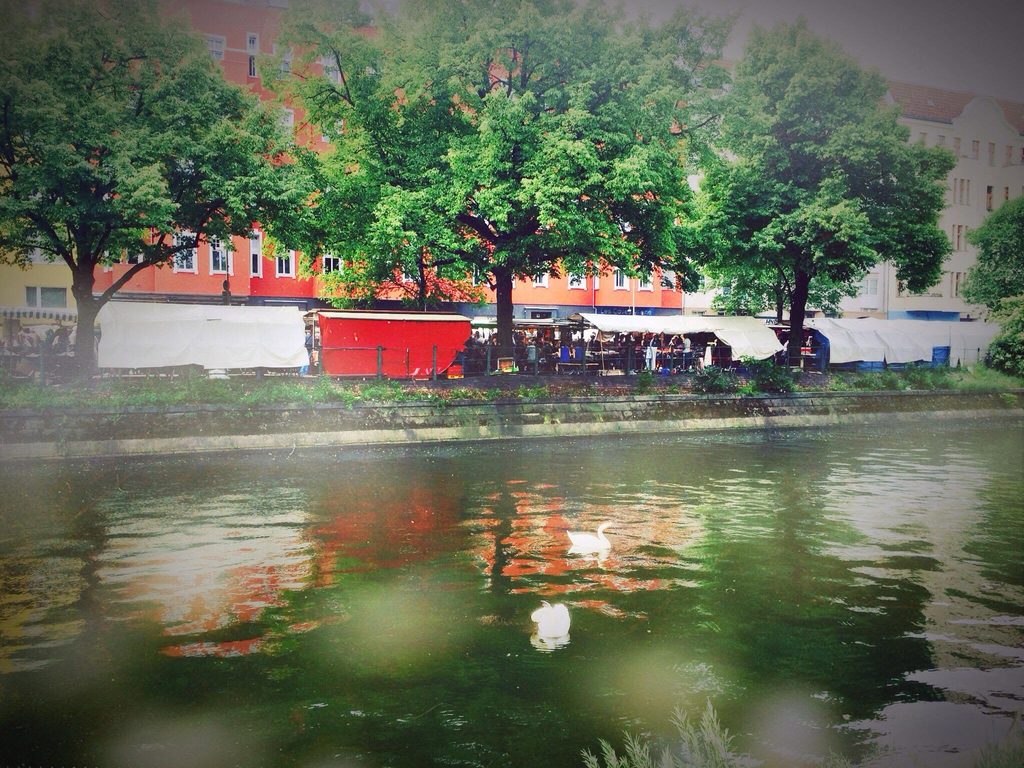
One of my favorite photographs from the trip captures an entirely different side of the city: a peaceful waterway lined with leafy green trees, colorful buildings, and outdoor market stalls.
Two white swans glide across the water.
It’s a wonderfully ordinary scene, and perhaps that’s what makes it so beautiful.
While Berlin’s historical landmarks remind us of humanity’s capacity for conflict, its parks, waterways, markets, and neighborhoods reveal something equally important.
Life continues.
People gather. Markets open. Trees grow. Swans drift across the water.
The Street Art of Berlin
Berlin also has an unmistakably rebellious creative spirit.
Wandering through its streets, I came across unexpected pieces of art, including a rusted miniature tank sculpture sitting on a cobblestone sidewalk.
It was strange, gritty, and fascinating.
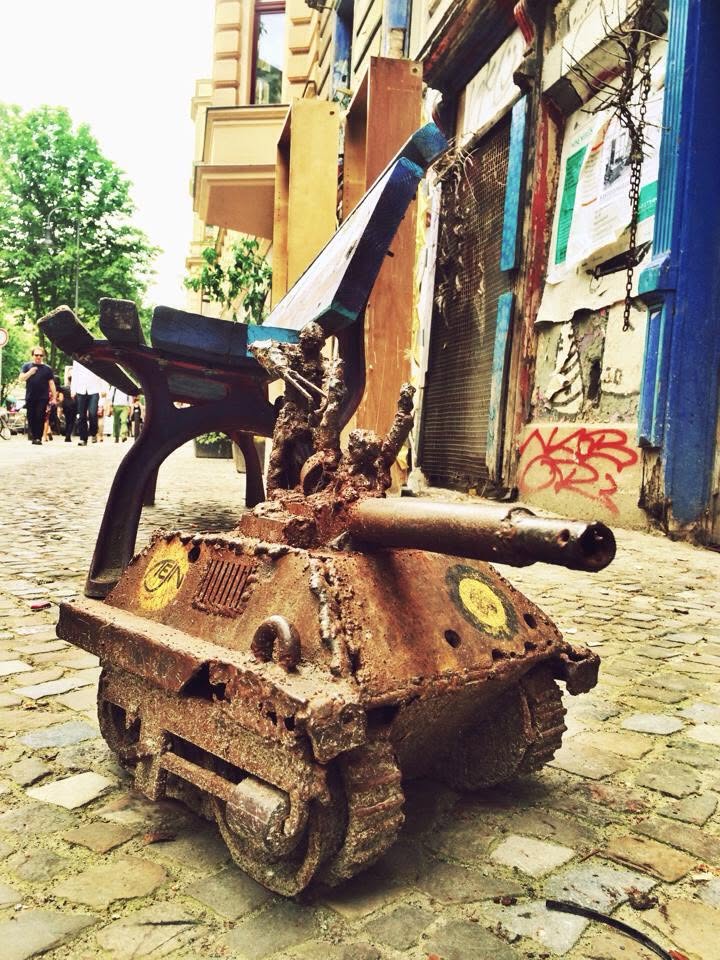
In a city whose history has been so profoundly shaped by war and political division, even something as simple as a miniature tank transformed into art seemed to carry a message.
Berlin felt like a place where people weren’t afraid to confront the past, challenge convention, and turn something ugly into something interesting.
What to See in Berlin in 3 Days
If you’re planning to spend 3 days in Berlin, these are some of the places I would prioritize, especially if you love history, culture, and exploring a city on foot.
Day 1: Discover Berlin’s Historic Center
Start at the Brandenburg Gate, then explore the nearby Reichstag area and the Memorial to the Murdered Jews of Europe. Continue toward Museum Island and the historic center.
This is a wonderful way to begin understanding Berlin’s complicated history and architectural contrasts.
Day 2: Explore the Berlin Wall and Cold War History
Visit Checkpoint Charlie, then spend time at the Berlin Wall Memorial on Bernauer Straße, where you can learn more about the division of the city and the people who lived through it.
If time allows, explore the East Side Gallery, a preserved stretch of the Berlin Wall transformed into an open-air art gallery.
Day 3: Experience Berlin Beyond the Monuments
Leave some time to wander.
Explore local markets, walk along the waterways, relax in one of Berlin’s many green spaces, or discover the city’s eclectic neighborhoods.
Some of the most memorable travel experiences happen when you stop following an itinerary and simply allow yourself to get lost.
A few practical tips:
TRANSPORT: Berlin has an extensive public transportation network, including U-Bahn trains, S-Bahn trains, trams, and buses. Comfortable walking shoes are essential, and it’s worth checking museum opening hours and ticket requirements before your visit.
STAY: I rented a magnificent room in a beautiful Berlin apartment through Airbnb. When I am traveling alone, I love doing this because I get to meet locals and get guidance from their perspective.
DANCE: My host gave me some great tips and guided me to an excellent club, Club der Visionäre, where I danced all night to world class DJs.
Three Days Between Two Worlds
Looking back, what makes these 3 days in Berlin so memorable isn’t just the landmarks or the photographs.
It’s where I was in my life.
I was traveling toward Kinshasa, a city that would introduce me to an entirely different world, with its own extraordinary history, contradictions, challenges, and beauty.
Little did I know what was waiting for me in Congo.
But then again, I rarely did when setting off on these adventures.
But that was part of the magic.
I had learned to trust that the world had something to teach me, even when I couldn’t possibly imagine what that might be.
Berlin was another reminder that the world is infinitely more complicated, fascinating, and beautiful than the stories we are often told about it.
And sometimes, even a three-day layover can become a meaningful part of a much bigger journey.
The destination was Kinshasa. But Berlin had a story to tell along the way.
Explore more of the magic.
Berlin was just one stop on a much bigger journey. From the streets of Europe to the rainforests of Central Africa, every place I’ve visited has left its mark on me.
Explore The Magic I’ve Seen, my interactive map of the places I’ve traveled, the stories I’ve collected, and the extraordinary people I’ve met along the way.