

There are places on this planet so extraordinarily beautiful that they almost defy description. Places where the landscapes seem too vast, the colors too vivid, and the scenery too surreal to possibly exist. The Namib Desert in Namibia is one of those places. I was fortunate enough to do a Namib Desert aerial photography tour.
Stretching along the Atlantic coast of southern Africa, this ancient desert is a spectacular world of towering orange dunes, barren plains, abandoned shipwrecks, and seemingly endless horizons.
And while the Namib Desert is magnificent from the ground, seeing it from the air is an entirely different experience.
Imagine climbing aboard a tiny Cessna, lifting off above the coastal town of Swakopmund, and spending the next two and a half hours staring wide-eyed and slack-jawed at some of the most beautiful, barren, poetic landscapes on Earth.
That’s exactly what I did on an aerial photography tour with Eagle Eye Aviation, and it remains one of the most epic photographic experiences of my life.
The Namib Desert: One of the Oldest Deserts in the World
The Namib Desert is widely considered one of the oldest deserts on Earth, with an arid history dating back millions of years.
Its landscapes stretch for more than 1,500 kilometers along the southwestern coast of Africa, creating an extraordinary meeting of desert and sea.
Part of this vast wilderness, known as the Namib Sand Sea, is a UNESCO World Heritage Site. Its enormous, shifting sand dunes are shaped by winds, ocean currents, and geological forces operating over immense stretches of time.
What makes this desert so visually spectacular is its diversity.
Deep red dunes rise above pale desert floors. Rugged mountains and dry riverbeds carve their way through seemingly endless stretches of sand. Along the Atlantic coastline, towering dunes collide with the deep blue ocean.
It is a photographer’s paradise.
A Scenic Flight Over the Namib Desert With Eagle Eye Aviation
One of the most extraordinary ways to explore the Namib Desert is by taking a Namib Desert aerial photography tour from Swakopmund.
My flight with Eagle Eye Aviation covered approximately 610 kilometers, beginning in Swakopmund, heading inland toward the remarkable dunes of Sossusvlei, and returning north along Namibia’s spectacular Atlantic coastline.
We flew in a small Cessna, accompanied by a second aircraft.
From the moment we left the ground, I was completely captivated.
Every few minutes, the colors and geography migrated into something entirely new.
One moment, enormous orange dunes stretched endlessly toward the horizon. The next, the earth transformed into rugged plains, mysterious geological formations, and patterns so perfectly arranged they looked like abstract paintings.
My camera barely got a rest during the entire journey.
An Ever-Changing Landscape
One of the most remarkable things about photographing the Namib Desert from above is the constant transformation of the landscape.
Wind carves enormous sweeping lines into the dunes, creating extraordinary shapes and shadows. The colors shift from golden yellow to rust red, deep orange, and soft pink.
From the air, the dunes resemble enormous ocean waves frozen in time.
The scale is almost impossible to comprehend.
At one point, I photographed the second Cessna in our party flying over the dunes. Against the vast expanse of the desert, the aircraft was barely visible.
A tiny speck in an enormous wilderness.
It was a beautiful reminder of just how small we are in the grand scheme of things.
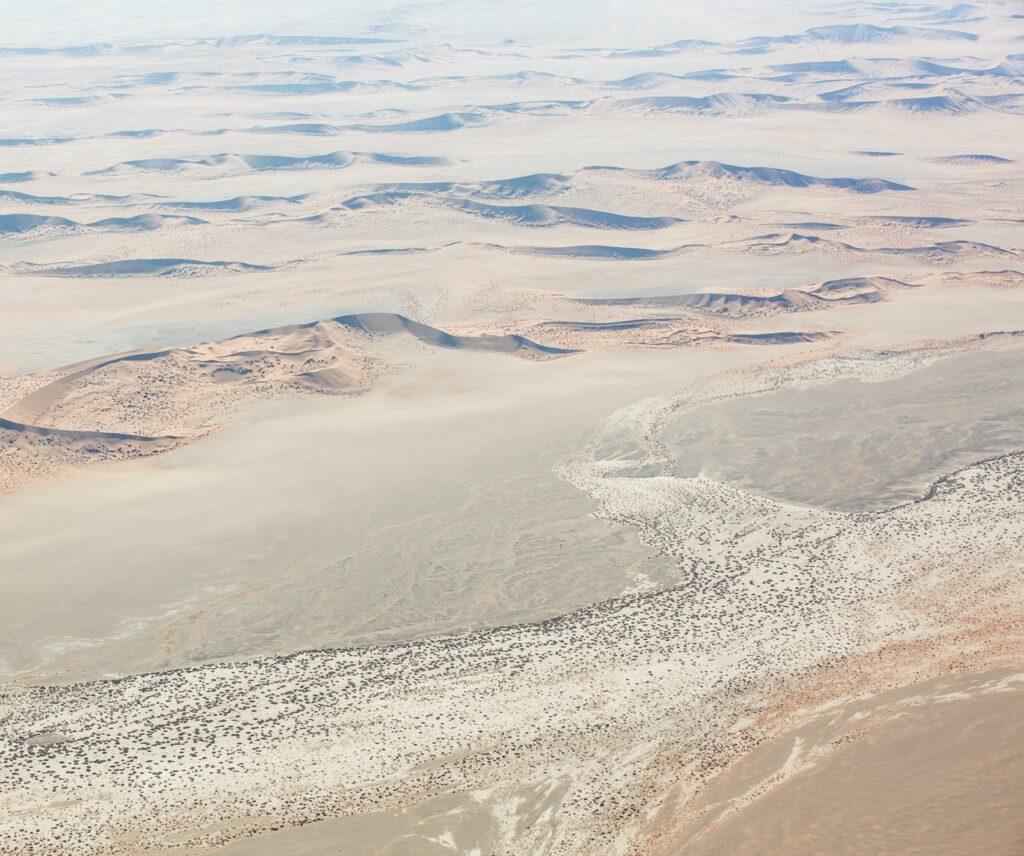
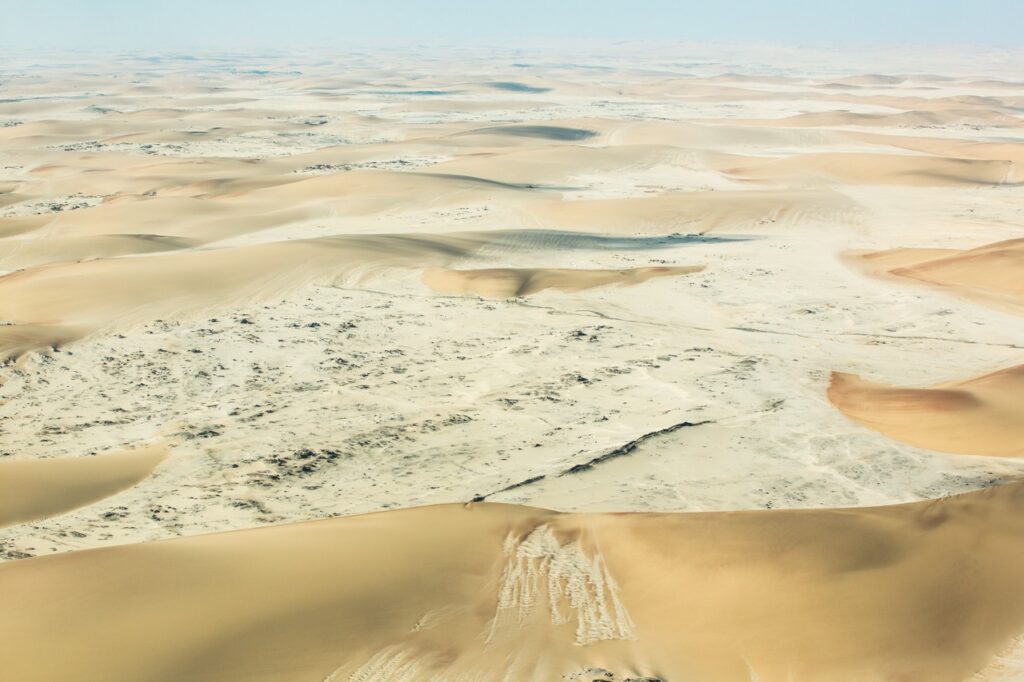
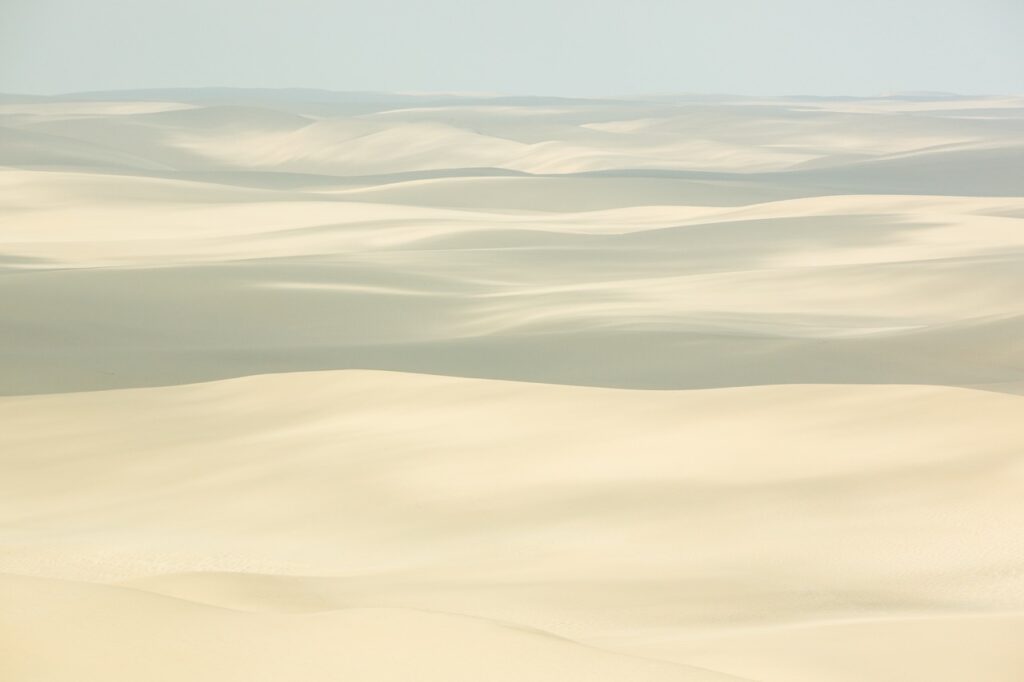
Aerial Photography in the Namib Desert
The Namib Desert is one of the most spectacular places imaginable for aerial photography.
The textures, colors, contrasts, and extraordinary scale of the landscape create endless photographic opportunities.
Before my flight, I had been reading about aerial photography techniques, and one recommendation kept coming up: photograph through open windows whenever possible.
Naturally, I asked our pilot whether we could open the windows.
He explained that we would be traveling too fast.
So every photograph I captured during the flight was taken through the aircraft’s window.
The glass added a slightly filtered appearance to many of the images, softening the colors and creating an almost dreamlike effect.
Rather than detracting from the photographs, I think it added something beautiful to them.
At one point, I caught a glimpse of myself and our little airplane reflected in a mirror attached to the wing.
There I was, suspended above this enormous wilderness, completely overwhelmed by the beauty of the world beneath me.
I caught a glimpse of myself in that desert.
It remains one of my favorite photographs from the entire experience.
Sossusvlei: Namibia’s Spectacular Sand Dunes
One of the highlights of an aerial tour over the Namib Desert is Sossusvlei, a spectacular region of towering sand dunes within Namib-Naukluft National Park.
Some of the dunes in this region are among the tallest in the world, rising hundreds of meters above the desert floor.
From above, their immense ridges form a seemingly endless ocean of sand, sculpted into extraordinary patterns by the wind.
The contrast between the sunlit slopes and deep shadows is especially dramatic, transforming the landscape into an enormous canvas of color and texture.
It’s difficult to imagine a more magical place for photography.
And yet, Sossusvlei is only one part of the extraordinary landscape along this route.
Where the Namib Desert Meets the Atlantic Ocean
Perhaps one of the most breathtaking sights along Namibia’s coastline is the place where the endless sand dunes meet the Atlantic Ocean.
The contrast is extraordinary.
On one side, enormous stretches of orange and golden sand extend into the interior of the continent. On the other, the deep blue Atlantic stretches toward the horizon.
Much of this coastline is almost completely devoid of human development.
Aside from a handful of coastal settlements, fishing activity, and scattered evidence of human habitation, there are vast stretches where the natural landscape dominates everything.
It is difficult to describe the feeling of looking out over so much open space.
There is something profoundly peaceful about it.
And something wonderfully humbling.
Shipwrecks Along Namibia’s Skeleton Coast
Namibia’s Atlantic coastline is famous for its shipwrecks, many stranded by dense coastal fog, dangerous currents, and treacherous conditions.
Two of the most fascinating wrecks visible along the southern desert coastline are the Eduard Bohlen and the Shawnee.
The Eduard Bohlen ran aground in 1909. Over the decades, shifting sands have left the vessel stranded hundreds of meters inland, creating the surreal sight of a shipwreck surrounded by desert.
The Shawnee, wrecked in 1976, is another remarkable relic of the coast’s maritime history.
Seeing these abandoned vessels from above is fascinating.
Rusting metal, enormous sand dunes, and the relentless Atlantic Ocean create a hauntingly beautiful scene.
Along the route, abandoned diamond mining camps provide additional glimpses into Namibia’s history.
These remnants of human activity seem almost insignificant against the immensity of the surrounding landscape.
Cape Fur Seals and the Salt Fields of Walvis Bay
The coastline is not entirely deserted.
Large colonies of Cape fur seals gather along Namibia’s Atlantic shores, with some colonies numbering in the hundreds of thousands.
From above, they appear as countless dark specks scattered along the coastline.
Further north, the commercial salt fields near Walvis Bay create another striking contrast to the natural landscape.
The geometric patterns of the evaporation ponds form fascinating shapes and colors when viewed from the air.
Just when you think the landscape cannot possibly become more extraordinary, something entirely new comes into view.
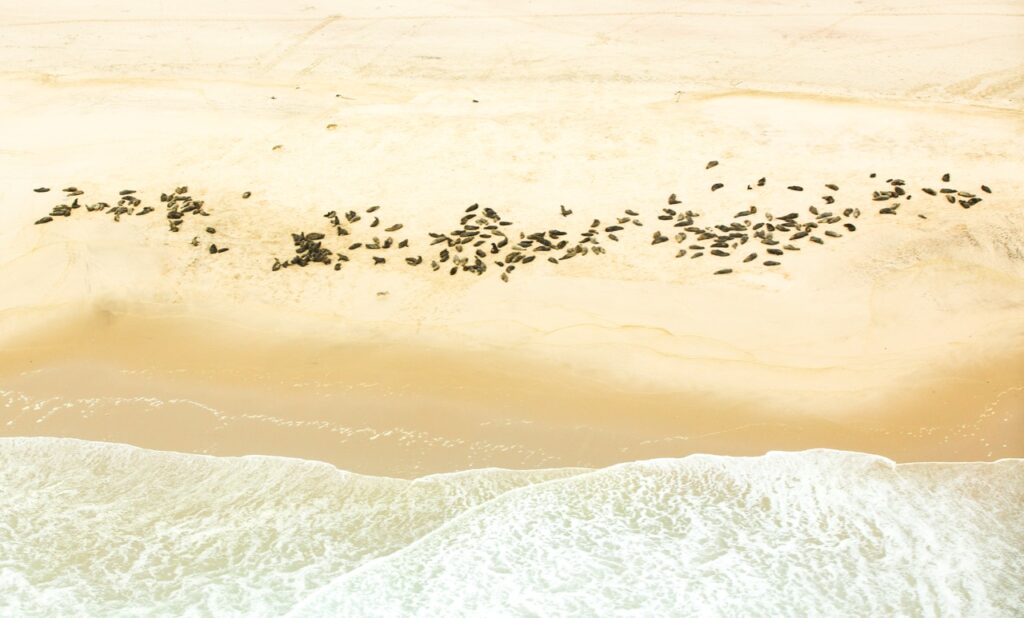
Booking a Namib Desert Scenic Flight From Swakopmund
For travelers planning a trip to Namibia, a scenic flight is an incredible way to appreciate the scale and diversity of the Namib Desert.
Eagle Eye Aviation operates scenic flights from Swakopmund Airport, offering routes over the desert, Sossusvlei, the shipwrecks, and the Atlantic coastline.
Their Sossusvlei scenic flight follows a route similar to the one I experienced, combining enormous dune fields, remote desert landscapes, abandoned mining camps, and spectacular coastal scenery.
Flight routes and durations vary, so it’s worth choosing an itinerary that includes the landscapes you’re most interested in seeing.
For anyone passionate about photography, nature, or simply discovering the extraordinary beauty of our planet, this is an adventure worth putting on your Namibia itinerary.
Tips for Photographing the Namib Desert From the Air
A few suggestions for making the most of an aerial photography adventure:
- Bring a camera you know well. The landscape changes quickly, and you’ll want to be comfortable adjusting your settings.
- Ask about window visibility. Shooting through aircraft windows can create reflections and slightly alter the colors of your photographs.
- Consider the lighting. Early morning or late afternoon sunlight can accentuate the enormous shadows and sculptural forms of the dunes.
- Choose a route that includes both the desert and coastline. The dramatic contrast between the dunes and the Atlantic Ocean is unforgettable.
- Look for patterns and perspective. Aircraft, shipwrecks, and other small objects can help communicate the enormous scale of the landscape.
- Put the camera down occasionally. As tempting as it is to photograph every moment, some experiences deserve to be appreciated without a lens between you and the world.
- Use a 70–200mm telephoto lens. Perfect for capturing sweeping desert landscapes and zooming in on intricate dune patterns, textures, and shadows. I used my Canon EF 70-200mm f/4L IS II USM Lens with a Canon EOS 5D Mark III DSLR Camera.
- Prioritize shutter speed. Shoot at 1/1000–1/2000 second to minimize motion blur caused by aircraft movement and vibrations.
- Set your aperture to f/5.6–f/8. This provides excellent landscape detail while allowing enough light for fast shutter speeds.
- Use Auto ISO. Start with a range of ISO 100–1600 to maintain proper exposure as lighting conditions change.
- Shoot in RAW. This gives you greater flexibility to recover highlights, shadows, and colors when editing.
- Use continuous autofocus and burst mode. Short bursts increase your chances of capturing sharp images from a moving aircraft.
- Minimize window reflections. Keep your lens close to the glass without touching it, and wear dark clothing to reduce reflections.
The Magic of the Namib Desert
There is something about Namibia that speaks directly to my soul.
The wide-open spaces. The extraordinary colors. The seemingly endless horizons. The feeling of being surrounded by landscapes so vast and beautiful that everything else in life seems to disappear for a little while.
Of all the places I have explored, Namibia remains one of the most visually spectacular.
And flying over the Namib Desert is an experience I would recommend to anyone who appreciates the extraordinary beauty of this planet.
A tiny plane. An endless ocean of sand. Shipwrecks, dunes, and the Atlantic stretching toward the horizon.
Two and a half hours of absolute magic.
Sometimes the world is just so magnificent that all you can do is stare, wide-eyed and slack-jawed, and be grateful to be here.
Explore more extraordinary places and unforgettable adventures through The Magic I’ve Seen, part of All the Magic—a collection of stories, photography, and reflections from a life spent exploring this extraordinary planet.