
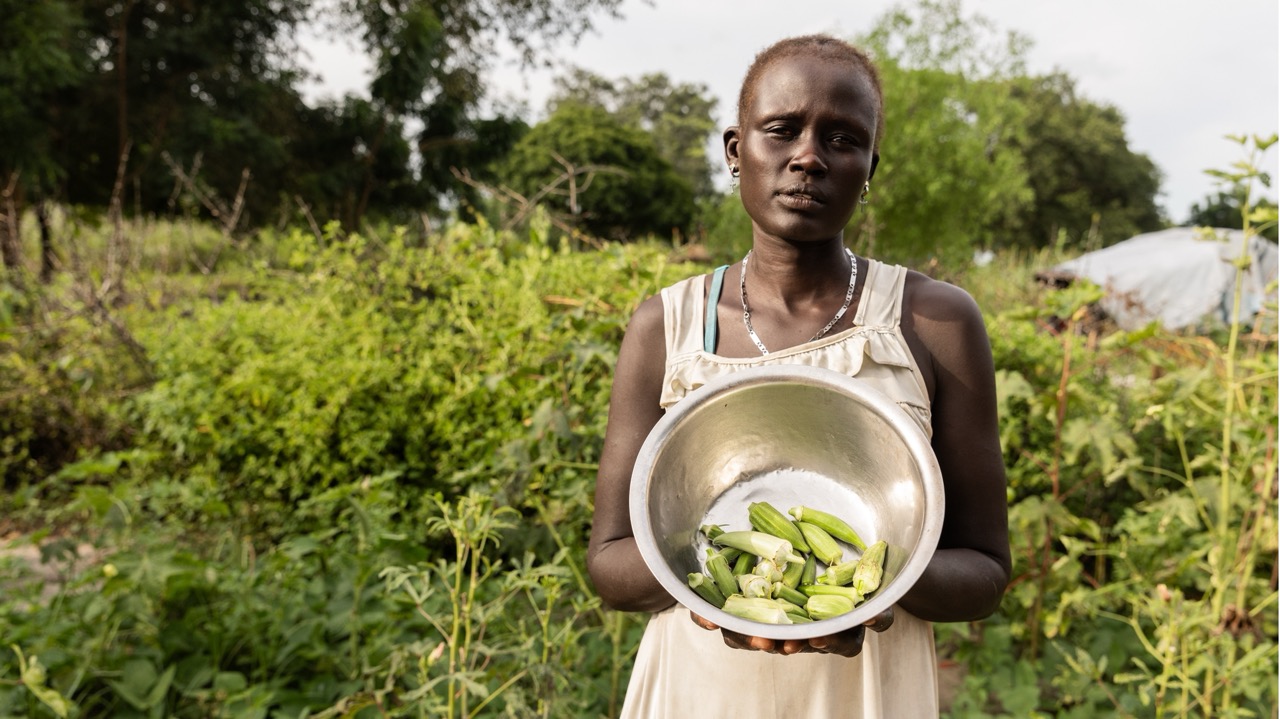
In the remote wetlands of Ayod, South Sudan, where war and rising waters have forced entire communities to abandon their homes, I met a woman whose extraordinary journey revealed what it truly means to survive.
The Journey to Ayod
Getting to Ayod, South Sudan, was an adventure in itself.
I boarded a United Nations Humanitarian Air Service flight bound for the remote reaches of Jonglei State, a vast landscape of wetlands, seasonal floodplains, and villages scattered across an unforgiving wilderness.
At a remote airstrip, we transferred to a UN helicopter for the final leg of our journey.
From above, the landscape stretched endlessly beneath us. This was a place where water dictated the rhythms of life, where roads could disappear beneath seasonal floods, and where entire communities were forced to move whenever the land they occupied became uninhabitable.
But water was only one of the forces driving people from their homes.
Years of civil war and intercommunal violence had created a population perpetually on the move. Families fled fighting, settled somewhere new, and sometimes found themselves displaced all over again when the floods arrived.
Even the health clinics had to be temporary. Built from tents rather than permanent structures, they could be dismantled, packed up, and moved whenever the population was forced to relocate.
It was humanitarian work designed around the reality that nothing here could be taken for granted. Not the roads, not the land, not even the communities themselves.
For one week, I lived in a small mud hut, sleeping inside a little tent that I had pitched on the earthen floor.
At night, the darkness came alive.
I lay awake listening to insects and other creatures moving through the hut, their tiny movements amplified by the stillness. Occasionally, the distant crack of gunfire punctuated the night, a reminder that war in this region was never very far away.
It was a world away from anything resembling ordinary life.
And yet, for the people I had come to meet, this was ordinary life.
We sloshed through marshy paths, ankle-deep in water, surrounded by grass that towered above our shoulders. For nearly an hour, we made our way through the wetlands before finally reaching a remote little corner of the earth.
It was here that I met Nyalual Mathieng.
Seven Days on the Water
When the floods came to Nyalual’s village, she was already carrying more grief than most people could bear.
Her husband had been killed on the front lines of South Sudan’s civil war, leaving her widowed, three months pregnant, and alone with three young children.
Then the water began to rise.
At first, she ran toward higher ground, gathering her children and whatever she could carry. But the water kept coming.
Everywhere she turned, the land was disappearing beneath it.
She ran again.
And again.
There was nowhere left to go.
Eventually, she found a canoe.
She loaded her three children into the small wooden vessel and began paddling, searching for somewhere safe.
For seven days, Nyalual navigated the floodwaters with her children in that canoe.
Seven days without a home. Seven days without knowing where they would sleep next, where they would find food, or whether the water would ever end.
Each evening, when darkness fell, she draped a mosquito net over the canoe to protect her children from the mosquitoes that carried malaria.
Beneath that thin veil of netting, her children slept while their mother kept them afloat in a world that had quite literally swallowed everything they knew.
I have often thought about those nights.
About a pregnant mother, recently widowed, alone on an endless expanse of water with three small children depending entirely on her.
What must have gone through her mind?
Was she terrified? Exhausted? Did she ever wonder whether they would survive?
I didn’t ask her those questions, and I won’t pretend to know the answers.
What I do know is that she kept paddling.
For seven days.
And when she finally reached dry ground, her journey still wasn’t over.
She gathered her children and walked for another three days until they reached Ayod, South Sudan.
Ten days of displacement. Ten days of searching for safety.
And the beginning of an entirely new struggle.
A Different Kind of Hunger
By the time Nyalual and her children reached Ayod, South Sudan, they were severely malnourished.
Surviving the journey had been one battle. Finding enough food to keep her children alive was another.
In a region where displacement, conflict, and flooding repeatedly disrupt agriculture and access to markets, hunger is a persistent threat.
Families often depend on a limited number of staple foods, particularly sorghum, a hardy grain that can be grown in challenging conditions.
But surviving on sorghum alone does not provide all the nutrients growing children need.
After arriving in Ayod, Nyalual gave birth to a daughter, Nyaun.
When the baby became ill, Nyalual learned about a nearby health and nutrition program.
Nyaun received therapeutic food to treat her malnutrition, while Nyalual began learning something that would eventually transform her family’s future: how to grow and prepare a wider variety of nutritious foods.
She attended cooking demonstrations at a community garden, where mothers learned to prepare meals using locally grown vegetables.
One of the recipes she learned was okra soup.
It was a simple dish, but it opened the door to something much bigger.
The Garden
When I visited Nyalual, she was preparing food for her family.
I watched as she worked with the familiar ingredients of her daily life, including sorghum and okra, explaining how she had learned to incorporate vegetables into her children’s meals.
She had also begun growing her own food.
Using seeds she received through the community garden program, Nyalual established a thriving okra garden.
Soon, she was producing more than her family needed.
And that surplus changed everything.
She began taking the extra okra to the market, where she could sell it and earn a little money.
For a woman who had once fled her home with three children in a canoe, the ability to grow food and generate an income represented something profound.
It meant she had options.
It meant she could provide for her family.
And, most importantly to her, it meant she could send her children to school.
A Better Life for My Children
Throughout my time in Ayod, South Sudan, I asked the people I met a simple question.
What is your greatest hope for your family?
The answer was always the same.
Education.
Not wealth., not possessions, not some grand vision of a different life.
They wanted their children to go to school.
For parents who had experienced the devastation of war, displacement, hunger, and unimaginable loss, education represented a future beyond the circumstances into which their children had been born.
When I asked Nyalual about her hopes, she told me:
“I am planning for a better life for my children. My children are in school because of this project. I planted some vegetables from [the] seeds and I sold the extra in the market to pay school fees.”
“I am planning for a better life for my children. My children are in school because of this project. I planted some vegetables from [the] seeds and I sold the extra in the market to pay school fees.”
I have carried those words with me ever since.
Here was a woman who had lost her husband to war, her home to floods, and nearly her children to hunger.
A woman who had paddled a canoe for seven days and walked for three more, pregnant and alone, searching for a place where her family might survive.
And when she finally had the opportunity to build something for herself, she planted a garden.
Not simply to feed her children today, but to give them a different tomorrow.
What We Carry
When my week in Ayod came to an end, I packed my belongings, left my little mud hut, and began the long journey back.
I would board another helicopter, another plane, and eventually return to a world where electricity, clean water, grocery stores, and schools were ordinary parts of daily life.
Nyalual would remain in Ayod, tending her garden, raising her children, and navigating the uncertainty of life in a region where both war and water could uproot a family without warning.
The contrast was impossible to ignore.
I had traveled halfway around the world to reach her.
She had traveled through floodwaters and wilderness to keep her children alive.
Our journeys had brought us together for only a brief moment, but hers would stay with me long after I left South Sudan.
I often think about the image of that canoe, drifting through the darkness beneath a mosquito net.
And then I think about Nyalual standing in her garden, growing okra to pay her children’s school fees.
There is something extraordinary in the distance between those two images.
Not because her hardships had magically disappeared, or because a garden could erase the trauma of war.
But because, after everything she had endured, Nyalual was still planning for the future.
And that future began with something as simple, and as powerful, as sending her children to school.
There’s more to the story.
Every photograph holds a story. Every journey leaves something behind.
Join The Magic Circle for an intimate look behind the lens—through personal journals, untold stories, photographs, and reflections from a life spent exploring the extraordinary corners of our world.
Come a little closer to the magic.